

Happy New Year! We're so glad you're here. Whether you're sipping your morning coffee or winding down after a long day, you've just taken the first step toward making 2026 your most intentional year yet. Let's do this together.
Here's a surprising statistic: 92% of New Year's resolutions fail by February.
Yep. February. That's like... five weeks. Most of us can't even keep a houseplant alive that long.
But here's the thing nobody tells you: the problem isn't your willpower. It's not that you're lazy or undisciplined or "just not a morning person." The problem is that most people set vague goals on January 1st without a clear roadmap to follow through.
"I'm gonna get fit!" Cool. What does that mean?
"I'm gonna save money!" Great. How much? By when? For what?
"New year, new me!" Okay, but... who's the new you? What do they want? What do they actually care about?
What You'll Walk Away With
By the end of this guide, you'll have:
- A clear life vision that actually excites you (not some generic "be better" nonsense)
- A visual vision board you can use as daily inspiration
- Your Q1 Life Goals (January-March) broken into monthly milestones
- Your bucket list for 2026—the experiences you don't want to miss
- A planning ritual you'll actually want to stick with
Plus a free copy-paste template you can use in Google Docs, Apple Notes, or your journal. (Or open in Notion if that's your thing.)
Sound good? Grab your coffee (or chai, if that's your vibe), find a cozy spot, and let's do this.
Before You Start
Grab these two resources to make your planning session even better:
Planning Template
All the prompts and exercises from this guide in one interactive template. Open in Notion to duplicate it to your workspace, or copy the content to use in Google Docs, Apple Notes, or your journal.
Focus Music
We curated this 2-hour ambient soundtrack specifically for this New Year planning session. Calming lo-fi beats with no lyrics to keep you focused without distraction.
Table of Contents
| # | Section | Time |
|---|---|---|
| 1 | Fresh Start Ritual | 10 min |
| 2 | Past Year Reflection | 20 min |
| 3 | Gratitude & Letting Go | 10 min |
| 4 | Life Vision Dreaming | 25 min |
| 5 | Vision Board Creation | 25 min |
| 6 | Bucket List Magic | 10 min |
| 7 | Q1 Life Goals | 15 min |
| 8 | Monthly Milestones | 10 min |
| 9 | Habit Foundations | 15 min |
| 10 | First Bold Action | 5 min |
| Total Time | ~2.5 hours | |
Note: Times shown are for doing the activities yourself, not reading time. Take whatever pace feels right for you.

1. Fresh Start Ritual
Before we dive into the deep stuff, let's set the vibe. This isn't just "planning". This is designing your life. That deserves a little ceremony, don't you think?
Create Your Sacred Space
Here's your pre-game checklist:
- Clear your desk (or table, or cozy corner) of clutter. Yes, that random pile of papers. Move it.
- Light a candle or turn on some soft ambient lighting. We're going for "intentional ritual," not "fluorescent office at 3pm."
- Put your phone on Do Not Disturb. Instagram can wait. Your future self will thank you for this uninterrupted time.
- Grab your journal or planning template
- Make yourself a warm drink. Coffee, tea, hot chocolate... your choice!
Your Opening Intention
Take three deep breaths. Seriously, do it. I'll wait.
Done? Good.
Now, write your answer to this question (don't overthink it, just let it flow):
Your Opening Intention
This is your North Star for the session. It doesn't have to be perfect or profound. It just has to be yours.
You don't have to see the whole staircase, just take the first step.
Martin Luther King Jr.

2. Past Year Reflection
Alright, here's where most people get stuck: they try to plan the future without understanding the past. It's like trying to navigate somewhere new without knowing where you're starting from. It helps to know your starting point first.
The most successful people don't just set goals. They learn from what actually happened. Tim Ferriss calls this the "Past Year Review" and considers it more valuable than New Year's resolutions. (And the guy's written like five bestsellers, so maybe he's onto something.)
The Calendar Walk-Through
Open your 2024 calendar (digital or physical) and go month by month. For each month, jot down:
- Major events and milestones
- People you spent time with
- Projects you worked on
- Travels or experiences
As you review, pay attention to your gut. Which memories make you smile? Which ones make you cringe or feel drained?
Pro tip: This is reconnaissance, not judgment. You're gathering data, not writing a performance review for yourself.
James Clear's Three Questions
James Clear (the Atomic Habits guy with over 3 million email subscribers) uses just three questions for his annual review. Simple, but powerful:
James Clear's Annual Review
Tim Ferriss's Positive/Negative Analysis
Want to go deeper? Try this: Create two columns and fill them out:
Tim Ferriss's Past Year Review
This isn't about being overly critical or beating yourself up. It's about noticing patterns. What gave you energy? What depleted you?
Key insight: The goal for 2026 isn't to do more. It's to do more of what lights you up, and less of what drains you.

3. Gratitude & Letting Go
Before we design the future, let's honor the past. Gratitude isn't just some feel-good exercise—research shows it rewires your brain to notice opportunities and resilience. (Seriously, there's neuroscience on this.)
Your 10 Gratitudes
Write 10 things you're grateful for from 2024. Big or small. Serious or silly. The fact that your houseplant survived counts.
Your 10 Gratitudes
Letting Go
Now, here's the hard part: what are you ready to let go of?
Habits that don't serve you. Limiting beliefs. Grudges. The need to be perfect. That career path that sounds good but doesn't feel right.
Letting Go Ritual
Write it down. Read it out loud if you want. Then take a deep breath and release it.
Letting go doesn't mean that you don't care about someone anymore. It's just realizing that the only person you really have control over is yourself.
Melody Beattie

4. Life Vision Dreaming
Okay, now for the fun part. We're about to dream big.
Most people never give themselves permission to ask, "What do I actually want?" They default to what they should want. What their parents want. What society expects. What looks good on paper.
Forget all that. For the next 25 minutes, you get to dream without limits.
The Vision Questions
Answer these honestly. Don't edit yourself. Don't worry about "how." Just dream.
Your 2026 Vision
Life Categories Deep Dive
Now let's get specific. For each major area of your life, envision where you want to be by the end of 2026:
Life Categories Vision
Take your time here. This is the foundation for everything that follows.
The future belongs to those who believe in the beauty of their dreams.
Eleanor Roosevelt

5. Vision Board Creation
Vision boards aren't woo-woo. They're neuroscience.
Your brain has a filter called the Reticular Activating System (RAS). It decides what information to let in and what to ignore. When you create a visual representation of your goals, you're training your RAS to notice opportunities that align with your vision.
Athletes do this. CEOs do this. Oprah does this. And now you're going to do this.
How to Build Your Vision Board
Digital version:
- Use Canva, Pinterest, or Google Slides
- Find images that represent your vision (Unsplash and Pexels are great for free high-quality photos)
- Add inspiring quotes or affirmations
- Choose colors that make you feel energized
- Set it as your phone wallpaper or desktop background
Physical version:
- Grab a poster board or large piece of paper
- Flip through magazines and cut out images that resonate
- Print photos from your vision answers above
- Glue everything down in a way that feels visually appealing
- Hang it somewhere you'll see it daily (bathroom mirror, desk, closet door)
Vision Board Elements
The key is to make it visual and visible. You want to see this every single day.
Your vision will become clear only when you can look into your own heart. Who looks outside, dreams; who looks inside, awakes.
Carl Jung

6. Bucket List Magic
A bucket list isn't morbid. It's a reminder that life is finite and precious.
Your 2026 bucket list isn't about "someday." It's about this year. What do you want to do, see, or experience in the next 12 months?
Your 2026 Bucket List
Write 10 things. Don't filter. Don't worry about logistics. Dream.
2026 Bucket List
Ideas to spark your imagination:
- Visit a place you've never been
- Learn a new skill (language, instrument, sport)
- Have a meaningful conversation with someone you admire
- Create something (art, music, writing, a business)
- Do something that scares you (public speaking, skydiving, asking someone out)
- Make a difference (volunteer, donate, mentor someone)
Once you have your list, pick one item and put a date on it. When will you do it? Block it in your calendar.
A goal without a plan is just a wish.
Greg S. Reid
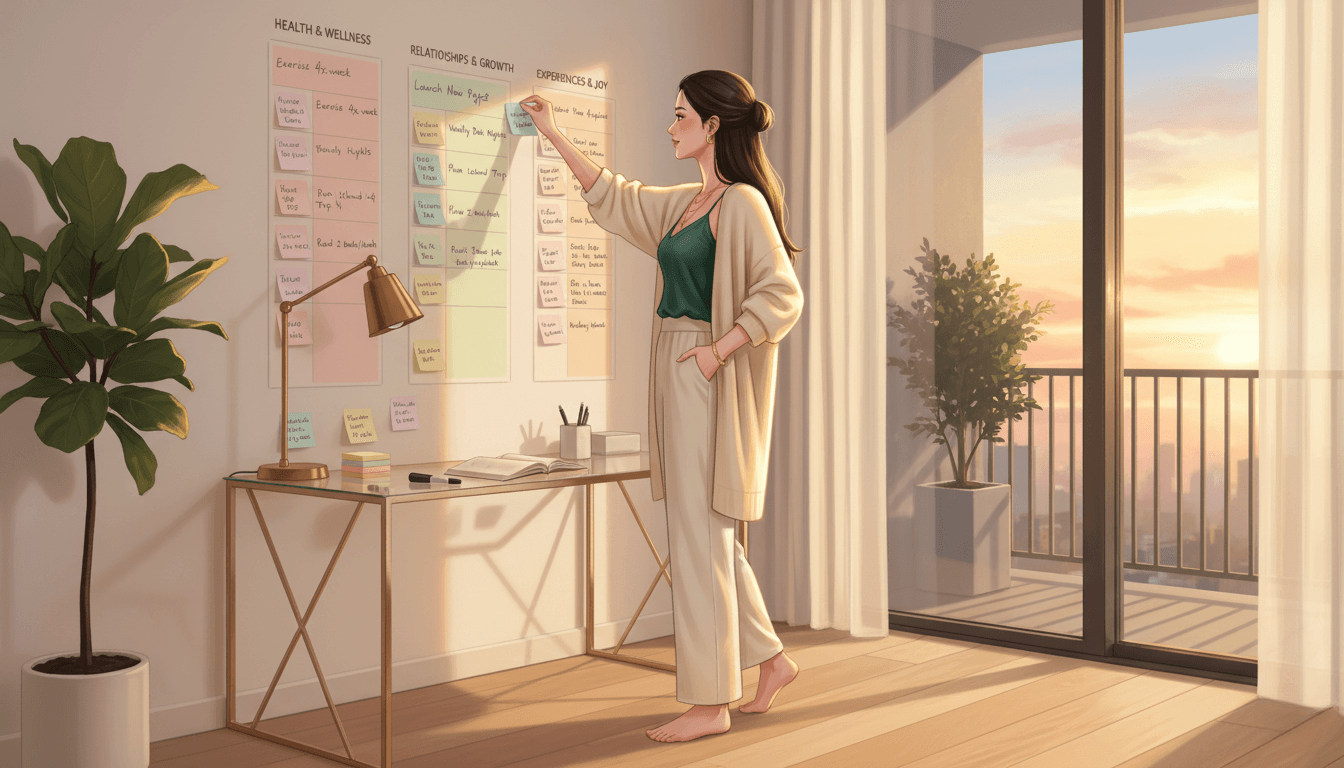
7. Q1 Life Goals
Now we get tactical.
Most people fail at New Year's resolutions because they try to change everything at once. You know what works better? 3-month sprints.
Instead of "2026 goals," let's focus on Q1 goals (January-March). Research shows that 12 weeks is the sweet spot for meaningful progress without burnout.
Your 3 Q1 Life Goals
Pick 3 goals that would make you proud by March 31st. Not 10. Not 5. Three.
For each goal, answer these questions:
Goal #1
Goal #2
Goal #3
Pro tip: Pick goals from different life categories. Don't make all 3 about work. Balance is key.

8. Monthly Milestones
Breaking goals into monthly milestones makes them feel achievable instead of overwhelming.
For each of your 3 Q1 goals, answer this:
Monthly Milestones
Now you have a roadmap. January milestone → February milestone → March milestone = Goal achieved.
Simple. Not easy. But doable.
You don't have to be great to start, but you have to start to be great.
Zig Ziglar

9. Habit Foundations
Goals are nice. Habits are what actually get you there.
James Clear (yes, him again) calls these keystone habits—small behaviors that trigger a cascade of other positive changes.
For example:
- Morning walk → better mood → more productivity → healthier eating
- Journaling → clarity → better decisions → stronger relationships
- Reading before bed → better sleep → more energy → improved focus
Your 3 Keystone Habits for 2026
Pick 3 habits that will support your Q1 goals and overall vision. For each one, use the Habit Stacking formula:
3 Keystone Habits
Example:
- "After I pour my morning coffee, I will write 3 gratitudes in my journal at the kitchen table."
The more specific, the better. Your brain loves clarity.
We are what we repeatedly do. Excellence, then, is not an act, but a habit.
Aristotle

10. First Bold Action
Alright, final step. And this is the most important one.
Research shows that if you take action within 72 hours of setting a goal, you're 80% more likely to follow through.
So we're not waiting. You're going to take your first bold action right now.
Your First Bold Action
Look at your Q1 goals. Pick one action you can take today (or this week) that moves you toward one of them.
First Bold Action
Do It. Right Now. Seriously.
If possible, take that action RIGHT NOW before closing this guide.
Send the text. Make the call. Sign up for the class. Write the first paragraph. Book the appointment. Download the app. Whatever it is.
Action creates clarity. Clarity creates confidence. Confidence creates more action.
The flywheel starts with one push.
Make It a Ritual
Planning isn't a one-time event. It's an ongoing practice. Here's the rhythm that actually works:
- Daily (5 min): Morning intention + evening reflection
- Weekly (15 min): Review progress and set priorities
- Monthly (30 min): Check milestones and adjust
- Quarterly (2 hours): Full goal review and reset
- Annually (2-3 hours): This complete life planning session
Need help staying focused during these sessions?
Try our Focus Timer with ambient music →
You Did It. (Like, Actually Did It.)
If you made it here and actually completed the exercises (not just read them, but wrote things down and thought about them), you're already ahead of 92% of people who set New Year's resolutions.
That's not nothing. That's actually kind of amazing.
You now have:
- Clarity on what actually worked (and flopped) in 2024
- A vivid vision of your ideal life
- A vision board to keep you inspired
- 3 meaningful Q1 goals with monthly milestones
- Keystone habits to support your goals
- Your first bold action, completed
Cheers to a new year and another chance for us to get it right.
Oprah Winfrey
2026 is yours. Now go build it.
And hey, be kind to yourself along the way. This stuff is hard. Progress isn't linear. And you're doing better than you think.
References & Inspiration
This guide was created by synthesizing wisdom from some of the best minds in productivity, goal-setting, and personal development:
Books & Authors
- James Clear: Atomic Habits and his Annual Review methodology
- Tim Ferriss: Past Year Review (PYR) framework from The 4-Hour Workweek and his blog
- Ali Abdaal: Feel-Good Productivity framework and Annual Planning Workshop methodology
- Brian P. Moran & Michael Lennington: The 12 Week Year quarterly goal-setting system
- Melody Beattie: The Language of Letting Go and reflective journaling practices
Frameworks & Resources
- Year Compass: Free annual planning workbook (yearcompass.com)
- Best Self Co.: Self Journal and 13-week goal methodology
- Wheel of Life: Life assessment framework attributed to Paul J. Meyer
Quotes Used
Melody Beattie, Martin Luther King Jr., T.S. Eliot, Eleanor Roosevelt, Carl Jung, Greg S. Reid, James Clear, Oprah Winfrey
About Superhuman Flow
We build tools and create content to help you focus deeply, work intentionally, and live fully. From our distraction-free Pomodoro timer to our focus music library, everything we create serves one mission: helping you achieve flow state and do your best work.
Try the Focus Timer | Subscribe on YouTube
Did this guide help you? Share it with someone who's ready to plan their best year yet.
If you found this helpful (or have suggestions to make it better), we'd love to hear from you on our support page.