
You set a 25-minute timer. Three minutes in, you check your phone. "Just one message," you tell yourself.
Five minutes later, you're scrolling Instagram. The timer buzzes. You've accomplished nothing.
Sound familiar?
Here's the brutal truth: many people abandon the Pomodoro Technique within their first few days—not because they lack discipline, but because they use it wrong.
This guide shows the common failure modes and the practical fixes that make Pomodoro easier to repeat.
What You'll Walk Away With
By the end of this guide, you'll have:
- 3 practical reasons why traditional Pomodoro often fails and how to make it easier to repeat
- 7 specific mistakes that commonly sabotage early Pomodoro attempts
- A practical 3-phase protocol for better follow-through across focus sessions
- 5 low-stimulation break activities that help you return to focused work
No fluff. No motivational speeches. Just concrete changes you can test in your next work session.
Before You Start
This guide is for you if:
- You've tried Pomodoro before and quit within a few days
- You struggle to focus for 25 minutes without distractions
- You want a structured system instead of generic productivity advice
Not for you if:
- You're looking for a quick hack (this requires deliberate practice)
- You expect instant results without changing how you prepare tasks and breaks
Why Most People Fail at Pomodoro
Before we dive into mistakes, understand this: Your focus is not the only problem. The setup around the timer matters too.
Here are 3 practical reasons why traditional Pomodoro fails for many people:
Reason #1: Your Brain's Energy Curve Doesn't Match the Timer
Gloria Mark, Daniela Gudith, and Ulrich Klocke found that interrupted work can come with more stress, frustration, time pressure, and effort. If a 25-minute block is full of small interruptions, the timer may create pressure without creating focus.
The cost of interrupted work: more speed and stress.
- Mark, Gudith & Klocke, CHI 2008 paper title
The problem? You start the timer before the task and environment are ready.
The fix: Adjust session length based on task type (more on this in Phase 2).
Reason #2: Breaks Don't Equal Recovery
A break is only useful if it actually gives your attention a rest. Scrolling feeds, checking messages, or opening another demanding task can keep your brain in input-processing mode.
The problem? Most people use breaks reactively-phone, email, snacks-none of which restore cognitive resources.
The fix: Pre-plan simple, low-stimulation break activities before you start (details in Phase 3).
Treat focus like a repeatable practice: reduce setup friction, protect the session from interruptions, and use breaks that make the next session easier to start.

Try Superhuman Flow's Smart Breaks
Our app automatically transitions to break mode when your session ends and offers guided breathing exercises to make recovery easier.
Start your first sessionReason #3: Willpower Depletion Kills Consistency
Repeated decisions make consistency harder. Every time you decide what to work on, where to start, and whether to take a break, you add another moment where friction can win.
The problem? Traditional Pomodoro requires constant decision-making: "Should I start now? Is this task ready? Do I need a break?"
The fix: Build rituals that remove decisions (covered in Phase 1).
The 7 Mistakes That Kill Focus
Now let's get tactical. These are common mistakes that make Pomodoro feel harder than it needs to be.
Mistake #1: No Predefined Task
What most people do:
Start a timer, then spend 5 minutes deciding what to work on.
Why it fails:
Decision fatigue at the start of a session creates friction before the real work begins.
The fix:
Write your task the night before. Be specific: "Draft introduction section for blog post" not "work on blog."
Mistake #2: Skipping Breaks
What most people do:
"I'm in the zone! I'll skip the break and keep going."
Why it fails:
Ariga and Lleras (2011) found that brief, occasional mental breaks can help prevent attention from dropping during sustained work. Skipping them often creates diminishing returns as sessions stack up.
Brief and rare mental breaks keep you focused.
- Ariga & Lleras, Cognition, 2011 paper title
The fix:
Treat breaks as non-negotiable. Set a second timer if needed.
Warning signs you're skipping breaks:
- Feeling "wired but tired" after 2 hours
- Making careless errors by afternoon
- Needing coffee to push through
Stay Consistent With Smart Breaks
Superhuman Flow automatically transitions to break mode when your session ends and intelligently schedules long breaks every 4th session-helping you maintain a sustainable rhythm.
Try the timerMistake #3: Reactive Break Activities
What most people do:
Timer buzzes → grab phone → scroll TikTok/Twitter/Instagram.
Why it fails:
Digital breaks often do not feel restorative because they keep your attention moving from input to input.
The fix:
Pre-plan 3 break activities before starting work:
- 5-minute break: Walk to window, look at distant objects (20-20-20 rule)
- 15-minute break: Walk outside, no phone
- 30-minute break: Eat protein-rich snack + stretch
Pro tip: Keep a "break menu" taped to your desk.
Mistake #4: Multitasking Within Sessions
What most people do:
Timer running → "quick" email check → Slack message → back to task.
Why it fails:
Context switching creates attention residue and makes it harder to return to deep work. A single email check can derail the entire session.
The fix:
- Digital barrier: Close email/Slack, use website blockers
- Mental barrier: Keep notepad for "remember to..." thoughts
- Task barrier: Keep one visible task for the session
Minimum viable change: Close communication apps before the timer starts.
Mistake #5: No Physical Separation
What most people do:
Work, browse, eat, and take breaks in the same seat with the same tabs open.
Why it fails:
When every activity happens in the same environment, your brain has fewer cues that work mode has started or ended.
The fix:
- Put your phone in another room, not just on silent
- Designate one deep work spot that is different from browsing or TV
- Use environmental cues: lamp on = focus mode, lamp off = break mode
- Move for breaks: stand up, switch rooms, or step outside briefly
Minimum viable change: Stand up between every Pomodoro.
Mistake #6: Ignoring Energy Levels
What most people do:
Schedule the hardest task during a low-energy window and then blame themselves when focus drops.
Why it fails:
Energy varies throughout the day. Scheduling your hardest work during your lowest-energy window makes consistency harder.
The fix:
- Track energy for 1 week; identify “golden hours” (often 2-4 hours after waking)
- Schedule deep work during peaks; meetings/admin during valleys
- Use shorter sessions for low-energy tasks instead of forcing the classic 25 minutes
Key principle: Fit the timer to the task and energy level, not the other way around.
Mistake #7: No Recovery Protocol
What most people do:
Lose focus mid-session, feel guilty, force themselves to continue, then avoid the next session.
Why it fails:
Self-criticism makes recovery harder. Treat a failed session as information, not a personal flaw.
The fix:
- Pause and name the distraction
- Remove the source if possible
- Take 3 slow breaths
- Restart with a smaller next action
Key principle: Treat distractions as data, not failures.
The deeper principle is simple: when the important task is clear before the timer starts, it becomes easier to ignore everything else until the session ends.
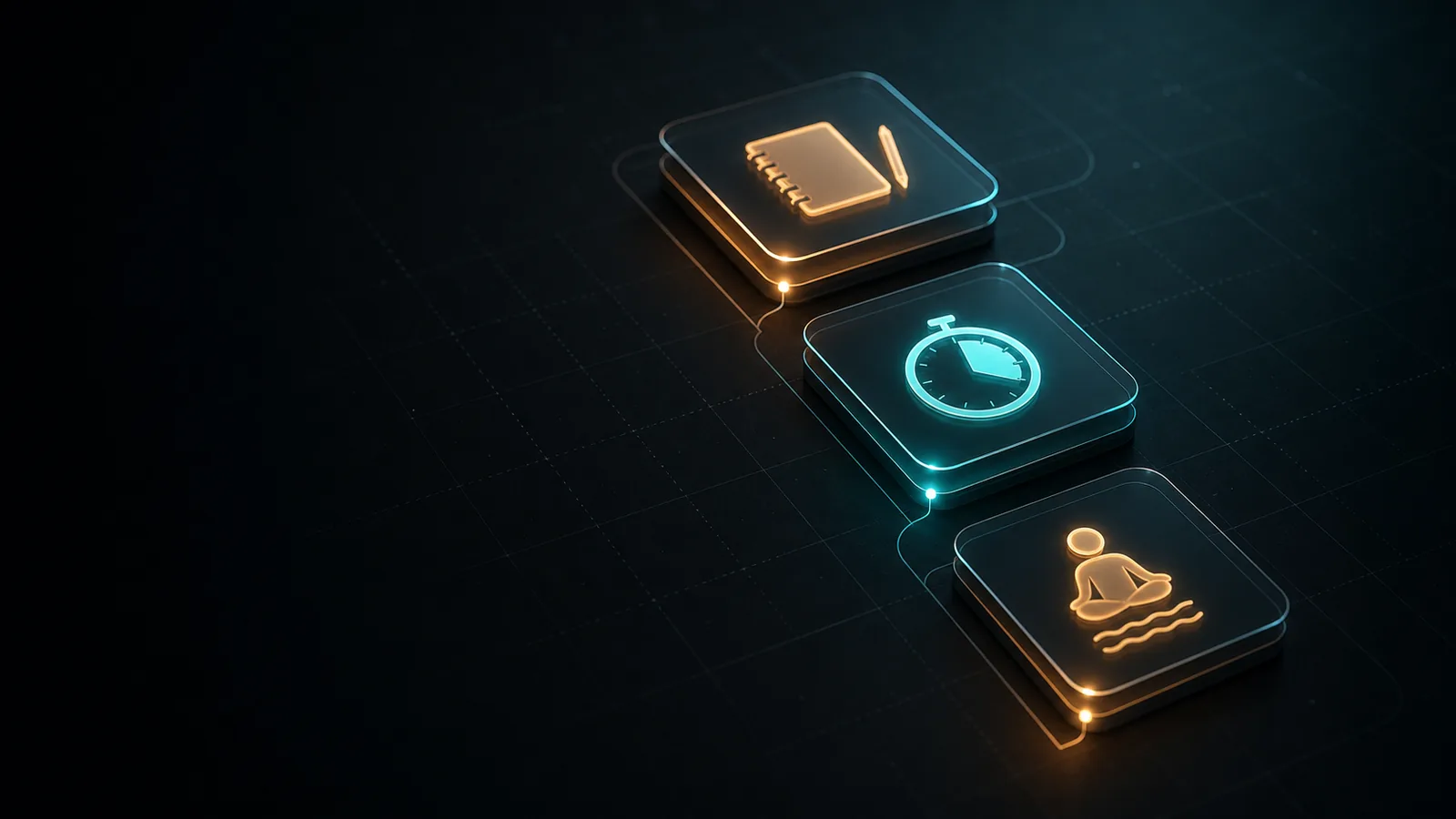
The 3-Phase Protocol That Works
Now that you know what not to do, here's a practical protocol that can make focus sessions easier to complete consistently.
Phase 1: Pre-Session Ritual (3 minutes)
Purpose: Prime your brain for focus, remove decision fatigue.
Step-by-step:
- Clear physical space (20 seconds)
- Remove everything from desk except task-related items
- Place water bottle in reach
- Phone in drawer/other room
- Review predefined task (40 seconds)
- Read task card out loud
- Visualize completed outcome
- Ask: "What's the one thing I'll accomplish?"
- Activate focus mode (60 seconds)
- Close all apps except necessary ones
- Enable website blocker
- Set "Do Not Disturb" on all devices
- Body scan (60 seconds)
- 3 deep breaths (4 seconds in, 6 seconds out)
- Notice tension, release shoulders
- Sit upright (better posture supports sustained focus)
Total time: 3 minutes
Result: Cognitive priming reduces startup friction before the timer begins.
This is why the system matters more than motivation. A repeatable setup removes decisions at the exact moment when distraction is easiest.
Phase 2: Deep Work Session (25 minutes)
Purpose: Single-task execution with external accountability.
Core rules:
- Timer is sacred
- Start timer only when Phase 1 complete
- No pausing unless emergency
- External timer (not phone app)
- Single-task only
- If new task pops up → write on notepad, continue
- No "quick" email checks
- No research rabbit holes (note for later)
- Physical anchors
- Focus music/brown noise (same playlist every time)
- Specific chair/location
- Timer visible but not distracting
Session length variations:
- Deep analytical work: 25 minutes (classic)
- Creative flow: 45 minutes (for experienced users)
- Challenging/boring tasks: 15 minutes (build tolerance)
Pro tip: Start with 15-minute sessions for first week. Master consistency before extending duration.
Focus Without Friction
Superhuman Flow's Pomodoro timer handles the logistics-start/pause/reset with one click, automatic break transitions, session tracking, and task integration-so you can focus on the work.
Start a session nowPhase 3: Recovery Break (5-15 minutes)
Purpose: Recover attention with a break that is deliberately different from work.
The principle:
Breaks are not laziness. They are part of the work cycle. The goal is to step away from demanding input, move your body, and return before the break turns into avoidance.
Break activities ranked by recovery effectiveness:
Tier 1: Highest Recovery (5-minute breaks)
- Walk outside (movement and daylight can make the next session feel easier)
- Box breathing (4-4-4-4 pattern; simple and low-stimulation)
- Look at nature (real view, window view, or a calm image)
Tier 2: Moderate Recovery (5-minute breaks)
- Stretch/yoga (helps you reset posture after sitting)
- Hydrate + healthy snack (nuts, fruit, not sugar)
- Listen to music (instrumental only, no lyrics)
Tier 3: Minimal Recovery (avoid for short breaks)
- Social media scrolling (too much input for a short recovery break)
- Email/Slack (no cognitive rest)
- YouTube/Netflix (passive consumption ≠ recovery)
Break protocol:
- After session 1-3: 5 minutes, Tier 1 activity
- After session 4: 15 minutes, Tier 1 + light snack
- After 4 sessions: 30 minutes, meal + walk
Critical rule: No screens during 5-minute breaks.
Pro tip: Set a second timer for breaks. Without structure, "5 minutes" becomes 20.
References & Inspiration
This guide uses practical productivity advice and a conservative reading of attention research:
Research & Studies
- Mark, Gudith, and Klocke (2008) on interrupted work, speed, stress, frustration, time pressure, and effort.
- UC Irvine summary of Gloria Mark's attention research on the reported 47-second average screen-attention finding.
- Ariga and Lleras (2011) on brief mental breaks and sustained attention.
- The official Pomodoro Technique site for the original method, 25-minute sessions, planning, interruption handling, and break structure.
Books & Authors
- Deep Work by Cal Newport for single-tasking and distraction-free work principles.
- Atomic Habits by James Clear for environment design, cues, and repeatable systems.
- Francesco Cirillo - Original Pomodoro Technique (1980s)
About Superhuman Flow
We build tools and create content to help you focus deeply, work intentionally, and live fully. From our distraction-free Pomodoro timer to our focus music library, everything we create serves one mission: helping you achieve flow state and do your best work.
Try the Focus Timer | Subscribe on YouTube
Did this guide help you? Share it with someone struggling to focus.
If you found this helpful (or have suggestions to make it better), we'd love to hear from you on our support page.